- built
- planned
Collecting consented speech in the languages of the Sahel
Public speech in Niger's languages comes from very few speakers, so we designed a programme to record consented speech with the people who speak them. This report gives the design; nothing has been collected yet.
What we found
Gap
Few speakers, and few kinds of speech
Of about 1,060 hours of public Zarma audio, about 10.7 hours are both openly licensed and transcribed, roughly 1%.
Fulfulde of central-eastern Niger
3 speakers open, 9.5 h
110 speakers test design, 10.2 h
Kinds of open Zarma speech
- Prompted spontaneous10.7 h
- Conversationnone open
- Telephonenone open
- Childrennone open
Where the open hours sit in the field has no meaning. Dots count speakers; how the hours divide among them is not in our data.
That open Zarma comes from seven speakers, and open Fulfulde of central-eastern Niger from three. Our test-set designs plan 100 and 110 speakers. We found no open Zarma conversational or telephone speech, no children's speech, and no public test set with many speakers kept apart from training.
Speakers
Five training voices were memorised
Fine-tuned on about seven hours from five speakers, a recogniser's training loss fell from 125 to 37 while held-out loss rose from 153 to 221, on scales that may differ.
Losses as the recipe reports them; the two may be on different scales, so read their directions only. One held-out speaker and one transcriber: indicative only.
On the held-out speaker, error fell from 29.0% to 25.7% folded character error rate, then stayed within 0.2 points from 2,000 to 5,000 updates. That is level with the best zero-shot recogniser, at 25.5%. With five speakers, longer training added little, so the programme aims first at the number of speakers.
Journey
One recording, from phone to dataset
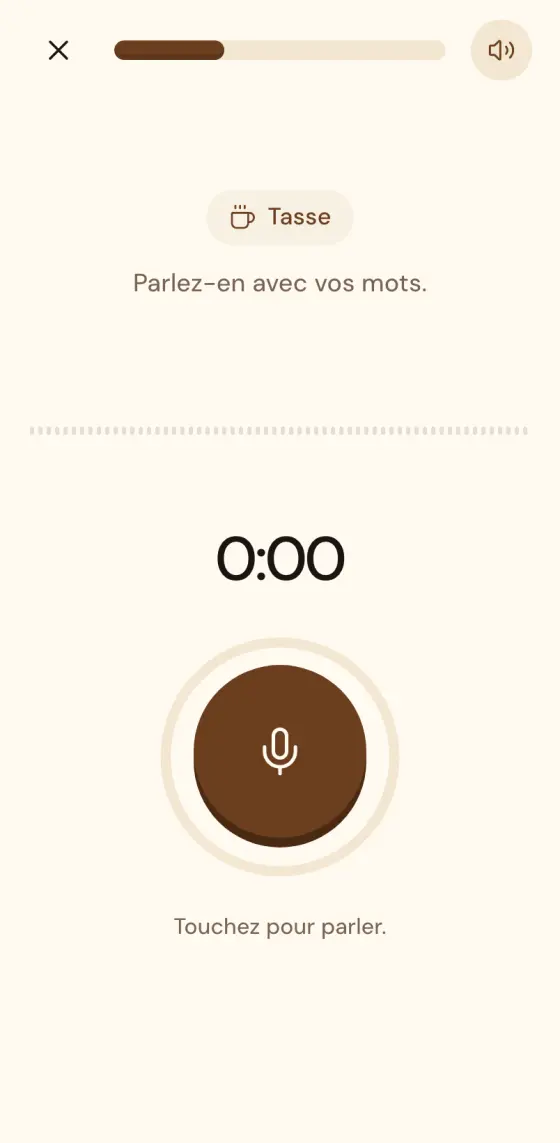
Adults record short spoken missions on the phone or the web, offline if needed. 113 missions are published in four recording languages.
Step 1 of 8
Record Built
The mission and the agreement revision are frozen before the microphone opens, and the recording points to the consent it was made under. Offline, the phone records only under a consent the server has already acknowledged.
The web app sends units of at most 60 seconds, retrying from 15 seconds up to 5 minutes. A receipt needs the server to read back the stored bytes. Two evaluators judge each recording without knowing who spoke. Two agreeing judgments decide, a split adds a third, and a rejection always needs two people. In the design, accepted recordings enter dated, frozen versions, and a withdrawal is purged from them within 7 days.
Test
A test set balanced by design
The planned Zarma test set has 100 adults, 50 women and 50 men, in four age bands, recorded with a facilitator under evaluation-only consent.
a womana mangender not shown
11.2 h hours by kind of speech
- Read 2.8 h 20 new sentences each
- Spontaneous 4.2 h about 2.5 min each
- Conversation 1.7 h 10 pairs, 10 min each
- Phone call 1.7 h 50 speakers
- Voice note 0.8 h 50 speakers
A design: nothing has been recorded. Each dot is one planned speaker.
By place of upbringing: Niamey 30, the Dosso region 25, the Tillabéri river valley 20 and Zarmaganda 25. About 11.2 hours in all: read sentences, spontaneous speech, two-channel conversations, ordinary phone calls and voice notes, transcribed twice without automatic drafts.
What comes next
- Native review of the spoken guidance and the agreement in each language.
- A first Hausa pilot by invitation.
- The server checks and compressed previews for evaluators.
- The first dataset version with its data statement.
- The Zarma and Fulfulde test sets.
- The studio voices for synthesis, under their own licence.
The paper
Collecting Consented Speech in the Languages of the Sahel: Design of a Mobile Programme
Namu AI LabNovember 202616 pagesPDF
Abstract
The main obstacle to speech technology for the languages of the Sahel is data. Our earlier explorations measured how little there is: of about 1,060 hours of public Zarma audio, about 10.7 hours are both openly licensed and transcribed, all from seven speakers; open transcribed speech in the Fulfulde of Niger comes to about 12 hours; there is no public conversational, telephone or children's speech in Zarma and no public test set with many speakers; and a recogniser fine-tuned on five speakers memorised their voices within about a thousand updates while its error on a new speaker stopped falling. We describe the programme designed in response. Adults record short spoken missions in Hausa, Zarma, Tamasheq and Fulfulde in a collection app on the phone and the web, under a versioned agreement bound to every recording. Recordings travel in small hashed units and count as received only when the server has read back the exact stored bytes. Evaluators who passed an identity check and a listening test judge each recording without knowing who spoke; two agreeing judgments decide, and a withdrawal is designed to reach every stored copy, datasets included. Speaker-balanced test sets of 100 to 110 speakers are to be recorded in assisted sessions under evaluation-only consent, and voices for synthesis in a studio under their own licence. Every set will carry a data statement and a frozen version. The programme is opening: no contributor's speech has been collected, the app has been tested only on a development deployment with synthetic accounts, and several parts are plans, which we mark. We report the design, the reasons for it, and its limits and risks.
Give this research more voices
What comes next needs consented speech from many more speakers. If you speak Hausa, Zarma, Fulfulde or Tamasheq, you can record short missions from your phone.