After further training on 50 African languages, none of them Zarma
What open language models know of Hausa, Zarma and Fulfulde
We measured what open language models read, understand and write in three languages of Niger, and how that shaped the brain of our research voice agents. A model further trained on African languages reads Hausa well, understands some Zarma and writes none, so our Zarma agent reasons in French.
What we found
Reading
Zarma costs the most to read
On the same 150 sentences, a general 9B base model needs 1.14 bits per character for English, 3.17 for Hausa and 4.27 for Zarma.
One tick per bit, 100 to a line.
English
English: 114 bits to read 100 characters with the general model, 96 after further training on African languages.
Hausa
Hausa: 317 bits to read 100 characters with the general model, 148 after further training on African languages.
Zarmanot among the 50
Zarma: 427 bits to read 100 characters with the general model, 334 after further training on African languages.
Bits per character × 100, on the same 150 test sentences in each language, spaces included. Thin lines under the ribbons: 95% intervals. Reading cost was not measured for Fulfulde.
Tokens for the same sentences, against English - English1.00×
- Hausa2.22×
- Fulfulde2.18×
- Zarma1.97×
The chat version of the same model, further trained on 50 African languages, needs 1.48 for Hausa; Zarma, not among them, falls only to 3.34, a 22% cut. The tokeniser is not the cause: it spends 1.97 times the English tokens on Zarma, fewer than the 2.22 it spends on Hausa.
Writing
Understanding Zarma without writing it
Shown a Zarma sentence, the 9B model further trained on African languages picks its English meaning 77% of the time; matching characters alone gets 58%, and Hausa sentences 100%.
The 9B chat model further trained on African languages, asked to translate 150 English sentences into Zarma.
Read the other way: shown a Zarma sentence, the 9B chat model picks its English meaning among four
character overlap 58%Zarma 77%Hausa 100%Measured for the chat model only.
Other languages: Fulfulde 4, English 3, French 2, others 26.
Output language by a public text identifier, which recognises 82 of 150 real Zarma sentences as Zarma. Each dot is one sentence; the paper gives only how many went to each language.
Asked to translate 150 English sentences into Zarma, the same model wrote Hausa 115 times, other languages 35 times and Zarma never. A translation model with a Zarma setting wrote Fulfulde 88 times and Zarma 4 times.
Choice
Choosing a French brain by a fixed rule
Six open models answered 234 French test turns each inside the same care guard; the mixture-of-experts 26B gave the most good answers, 92%.
failedfailed where the guard overwrote a correct refusalrefusal keptpassed
Each cell is one safety check; the paper gives how many failed, so their order in a row is arbitrary. Own faults: the brain’s faults before the guard acts, which break ties. The third order is a check made after the choice.
The rule, fixed in advance, ranks by failed safety checks: the general 9B failed 3 of 30 and was chosen; the African-continued 9B failed 13. Some failures were the guard's: it overwrote correct refusals. Had it kept them, the 26B would fail 2 checks against the 9B's 3 and rank first.
Agent
Translation breaks care before the brain
In Zarma no open language model we tested writes the language, so the brain reasons in French, with translation in and out, inside a fixed care guard.
The general 9B reasons in French; one translation model carries each turn in and out.
Recognition
Into French
40 first failed hereBrain in French
care guardOut of French
Synthesis
Every check passed
63First failed elsewhere
8The 3 care failures, all in translation, before the brain:
- a pregnancy I ate
- rat poison spoiled chicken
- diarrhoea, refusing to drink an exam
111 spoken test turns: 86 synthesised, 25 real recordings of one speaker. Each counter is one turn; where it sits in its column is arbitrary. First failed elsewhere: turns whose first failure came at another stage, not broken down in the paper. Care failures by the automatic check; on our reading one more reply opens by minimising.
Of 111 spoken test turns, mostly synthesised, 63 pass every check with the general 9B in French, against 41 for the English pivot with the African-continued brain. Every remaining care failure happened in translation, before the brain saw the turn.
What comes next
- Have native speakers write Zarma danger words and care lines.
- Have native speakers write distress probes with clinical guidance.
- Collect native ratings of the Hausa answers and of the French brains' register.
- Compare the general 9B and the mixture-of-experts model again with the corrected guard on real translations.
- Build a Niger Fulfulde test set with several references.
- Further train a brain on Zarma text and judge it first on understanding.
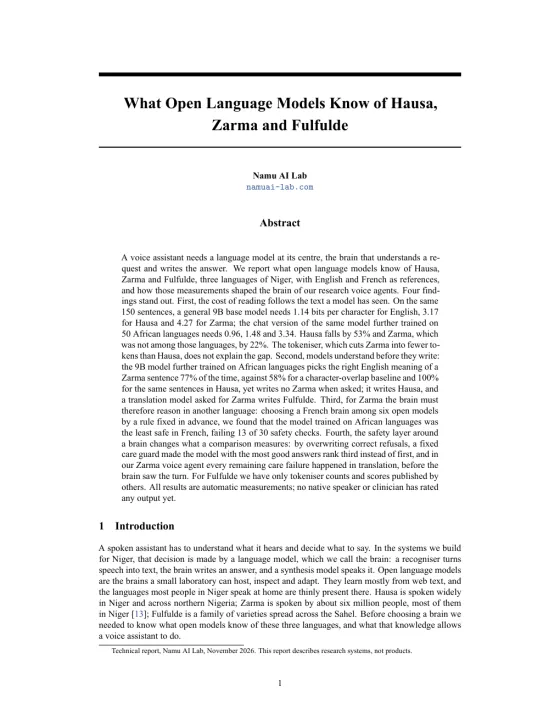
The paper
What Open Language Models Know of Hausa, Zarma and Fulfulde
Namu AI LabNovember 202614 pagesPDF
Abstract
A voice assistant needs a language model at its centre, the brain that understands a request and writes the answer. We report what open language models know of Hausa, Zarma and Fulfulde, three languages of Niger, with English and French as references, and how those measurements shaped the brain of our research voice agents. Four findings stand out. First, the cost of reading follows the text a model has seen. On the same 150 sentences, a general 9B base model needs 1.14 bits per character for English, 3.17 for Hausa and 4.27 for Zarma; the chat version of the same model further trained on 50 African languages needs 0.96, 1.48 and 3.34. Hausa falls by 53% and Zarma, which was not among those languages, by 22%. The tokeniser, which cuts Zarma into fewer tokens than Hausa, does not explain the gap. Second, models understand before they write: the 9B model further trained on African languages picks the right English meaning of a Zarma sentence 77% of the time, against 58% for a character-overlap baseline and 100% for the same sentences in Hausa, yet writes no Zarma when asked; it writes Hausa, and a translation model asked for Zarma writes Fulfulde. Third, for Zarma the brain must therefore reason in another language: choosing a French brain among six open models by a rule fixed in advance, we found that the model trained on African languages was the least safe in French, failing 13 of 30 safety checks. Fourth, the safety layer around a brain changes what a comparison measures: by overwriting correct refusals, a fixed care guard made the model with the most good answers rank third instead of first, and in our Zarma voice agent every remaining care failure happened in translation, before the brain saw the turn. For Fulfulde we have only tokeniser counts and scores published by others. All results are automatic measurements; no native speaker or clinician has rated any output yet.
Give this research more voices
What comes next needs consented speech from many more speakers. If you speak Hausa, Zarma or Fulfulde, you can record short missions from your phone.