About 11 of 268 hours are usable Niger speech
Fulfulde speech technology for Niger
We surveyed what exists for speech technology in Niger's two Fulfulde varieties. Of about 268 hours of open, transcribed Fulfulde speech, about 11 usable hours are from Niger, so we fixed a 110-speaker test plan before measuring anything.
What we found
Hours
Plenty of Fulfulde, little of it from Niger
Public collections hold about 268 hours of openly licensed, transcribed Fulfulde speech.
257 h fall through248 h from other varieties and 9.15 h of Western Niger speech whose transcripts do not fit their audio
Niger radio, by request only 291 h Machine drafts for 100 h. None checked by a person.
stays: a Niger variety, with a transcript that fits its audioanother varietyWestern Niger, transcript does not fit its audioOne square is one hour; the last square of a group is cut to its fraction. Varieties run roughly west to east; where a square sits in its pile or lands in the heap means nothing.
About 11 of those hours are in Niger's two varieties with transcripts that fit their audio: 9.5 hours from three eastern speakers and 1.15 western hours from two. The largest Niger source is 291 hours of gated radio, with machine drafts for 100 hours and none checked by a person.
Labels
Published labels often describe other speech
All 1,972 Fulfulde sentences of a read-speech set filed under a Senegal locale are Nigerian Fulfulde text; who read them is not documented.
Inside
Filed under SenegalNigerian Fulfulde text
All 1,972 sentences are lines of a Nigerian Fulfulde text set. Who read them is not documented.
Inside
Western Niger Fulfulde155 recordings fit their audio
Two speakers, 1.15 h. Text alone does not settle their variety.
- 596transcripts whose length does not follow the audio, under 4 speaker labels (7.94 h); 592 also appear in the Pulaar part
- 150fit their audio, but 140 also appear under one Pulaar speaker
- 5repeat another label’s recordings, with the same durations
- 155fit their audio and answer their prompts: 2 speakers, 1.15 h
One square per sentence or recording. The recordings are grouped by what the audit found; their order inside a group is not in the data. The audit read metadata and text only, without listening.
In the only open corpus labelled Western Niger Fulfulde, 596 of 906 recordings carry transcripts whose length does not follow their audio, so we hold it out.
Varieties
Niger's west and east are far apart
A dialect survey of eastern Niger found 34 to 53% lexical similarity with the west; eastern listeners understood a Nigerian text fully and the western text poorly.
Counting
Central-Eastern Niger Fulfulde uses Arabic loans for tens, and Hausa dubu for 1000.
- 5: not in our sources
- 6: not in our sources
- 20: asherin
- 30: talatin
- 1,000: dubu
Samples of 12,000 tokens, spelling folded. The Western Niger sample is 6,548 tokens from the speaker labels that hold its two speakers whose transcripts fit their audio; their variety is not settled. Only the number words the paper cites are shown.
In public text, eastern Niger speech sits beside Nigerian and Cameroonian data and far from Pulaar and Maasina. Numbers differ too: Western Niger Fulfulde and Pulaar count in fives, while Central-Eastern Niger Fulfulde uses Arabic loans for tens, so synthesis needs a variety switch.
Plan
A test set sized before any result
With 55 western and 45 eastern speakers, a real 1-point gain can show per variety; one region or the Woɗaaɓe alone can only be reported.
- West, 55 speakerspaired half-width 0.5can gate a 1-point gain
- East, 45 speakerspaired half-width 0.55can gate, only just
- Diffa, 10 speakerspaired half-width 1.0reported separately
Spread of the per-speaker difference, in points:11.5, assumed2.5 Seeded simulation, 300 replications of 1,000 bootstrap draws. The between-speaker spread has never been measured for Fulfulde; it will be re-estimated after the first 20 test speakers. One figure is one planned speaker; inside a group the order means nothing.
The Niger test set: 110 adults, half of them women, 55 western and 45 eastern speakers, plus 10 from Diffa reported separately. Models learn from the public pool, keep Hausa, Zarma and French by replay, adapt to Niger, and are promoted only through gates fixed in advance.
What comes next
- Check the public slices and build the public suite.
- Run zero-shot baselines on it, labelled as indicative.
- Record and freeze the 110-speaker Niger test set with native transcription.
- Settle a spelling convention with native speakers.
- Train and promote models for Western, then Central-Eastern Niger Fulfulde under the fixed gates.
The paper
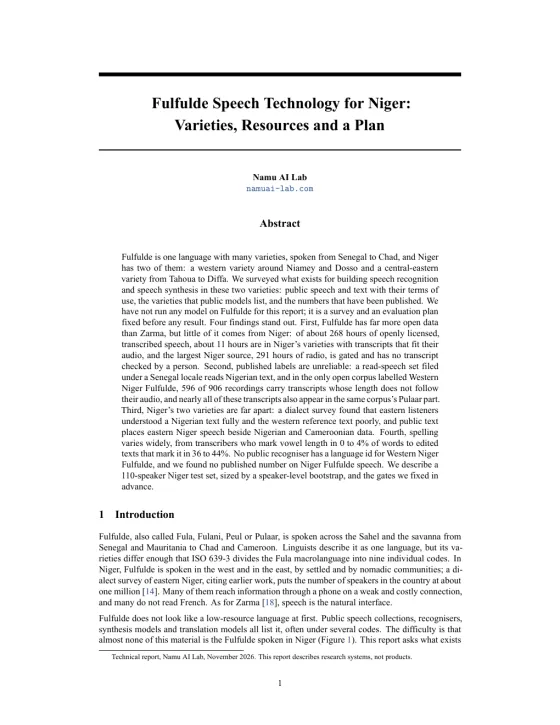
Fulfulde Speech Technology for Niger: Varieties, Resources and a Plan
Namu AI LabNovember 202617 pagesPDF
Abstract
Fulfulde is one language with many varieties, spoken from Senegal to Chad, and Niger has two of them: a western variety around Niamey and Dosso and a central-eastern variety from Tahoua to Diffa. We surveyed what exists for building speech recognition and speech synthesis in these two varieties: public speech and text with their terms of use, the varieties that public models list, and the numbers that have been published. We have not run any model on Fulfulde for this report; it is a survey and an evaluation plan fixed before any result. Four findings stand out. First, Fulfulde has far more open data than Zarma, but little of it comes from Niger: of about 268 hours of openly licensed, transcribed speech, about 11 hours are in Niger's varieties with transcripts that fit their audio, and the largest Niger source, 291 hours of radio, is gated and has no transcript checked by a person. Second, published labels are unreliable: a read-speech set filed under a Senegal locale reads Nigerian text, and in the only open corpus labelled Western Niger Fulfulde, 596 of 906 recordings carry transcripts whose length does not follow their audio, and nearly all of these transcripts also appear in the same corpus's Pulaar part. Third, Niger's two varieties are far apart: a dialect survey found that eastern listeners understood a Nigerian text fully and the western reference text poorly, and public text places eastern Niger speech beside Nigerian and Cameroonian data. Fourth, spelling varies widely, from transcribers who mark vowel length in 0 to 4% of words to edited texts that mark it in 36 to 44%. No public recogniser has a language id for Western Niger Fulfulde, and we found no published number on Niger Fulfulde speech. We describe a 110-speaker Niger test set, sized by a speaker-level bootstrap, and the gates we fixed in advance.
Give this research more voices
What comes next needs consented speech from many more speakers. If you speak Fulfulde, you can record short missions from your phone.