Fofo!Mate ni go?Mate kwaara?Mate goy?
Zarma speech technology from scarce data
Zarma is spoken by about six million people, most of them in Niger. We built and measured speech recognition, speech synthesis, translation and a first voice agent for it, from very little public data.
What we found
Data
The data is scarcer than it looks
We counted about 1,060 hours of public Zarma audio.
10.7 hours open and transcribed
- One radio collection, open by approval783 h
- All rights reserved151 h
- No derivatives allowed101 h
- Terms forbid reuse6.6 h
- Non-commercial or unlicensed5.6 h
- Open lesson audio, no transcripts0.9 h
- Open and transcribed10.7 h
Text
811,000 wordsOne 1989 Bible translation
244,000 wordsAll other clean text, nine sources
Hours as measured or reported by each source; areas to scale; the small overlaps between sources are ignored. Each line on a book’s edge is 10,000 words.
Three quarters sit in one radio collection, open only by approval. Most of the rest has all rights reserved or terms that forbid derivatives. About 10.7 hours are open and transcribed: prompted speech from seven speakers, about 1% of the audio. Text is no better. One 1989 Bible translation holds about 811,000 words; all other clean text we found adds up to about 244,000.
Measurement
Measurement is the hard part
The standard writes kaŋ. The transcripts of one public speech corpus write kan 968 times, and kaŋ 59 times.
The best recogniser’s character edits on the test speaker, by cause
a ga · agaaa · aŋ ɲ · n ny- ’hearing, and other spelling variationstill charged 64.6%The tail of ŋ is as long as the share written kaŋ.
About a third of what the best recogniser is charged as error is spelling convention: word boundaries, vowel length, ŋ and ɲ. Two public language identifiers call 82% and 78% of our 1,568 Zarma segments Hausa. So in our agent, the user chooses the language.
Together
Neighbouring languages, trained together
Fine-tuned on Zarma alone, our recogniser almost stopped writing Hausa’s hooked letters: of 502 in the Hausa test references, it wrote 131 before and 1 after.
Hearing a recogniser, on a Zarma and a Hausa test set Hausa error 4.6% → 12.4%
Hooked letters of Hausa written: 131, then 1, of 502
Speaking a synthesis model, its speech read back by a recogniser 46 of 700 Zarma renders read back with a Hausa letter
Lines join measured checkpoints; thin crosses are 95% intervals. Zarma speech: 700 renders; Hausa speech: 334 targets.
With Hausa mixed back in, about a fifth of the training, its Hausa error held at 5.3% instead of rising to 12.4%, and Zarma did not change. Trained only on Hausa, a synthesis model let Hausa into Zarma: 46 of 700 renders read back with a Hausa letter. Trained on both at once: 3. The same model then learned French. One model now speaks Zarma, Hausa and French, each within the tolerances we set before training.
Agent
In a voice agent, translation is the weakest link
No open language model writes Zarma. So our agent hears Zarma, reasons in French, and translates in and out.
the median turn
RecognitionInto FrenchLanguage modelInto Zarma, and speechEnd of speech and silence13 turns with real Zarma input
target 1.3 smedian reply 6.8 s- Recognition1.2 s
- Into French1.6 sthe first stage to fail in 40 of the 48 failed test turns
- Language model1.1 s
- Into Zarma, and speech2.2 s
- End of speech and silence0.9 s
By the 1.3 s target, none of the 13 turns had begun to reply; the first began at 5.9 s. The first turn after the service had been idle waited 202 s for the models to load.
What translation did to three requests for help
- pregnancy“I ate”
- rat poisonspoiled chicken
- diarrhoeaan exam
Hosted on one cloud GPU; real recordings of one speaker. Stage times are the differences between the timestamps of each turn.
In most failed turns, the first stage to fail was translating what the recogniser heard. In requests for help, it changed the meaning. Three versions so far. The best passes 63 of 111 test turns through every stage, up from 23 and then 41. Its median reply starts 6.8 seconds after the user stops speaking; our target is 1.3. Translation in both directions takes the largest share.
The same greetings, twice
Read by a consenting speaker, then by our joint model in that voice, on one time scale.
What comes next
- Native speakers rate the outputs, with decision rules fixed in advance.
- A test set of 100 speakers, and consented voices recorded for synthesis.
- Care lines and distress probes written by native speakers with clinical guidance, before any public demonstration.
- Streaming and shorter translation paths, to bring the reply delay down.
- Further on, one model that hears and speaks Hausa, Zarma and French directly.
The paper
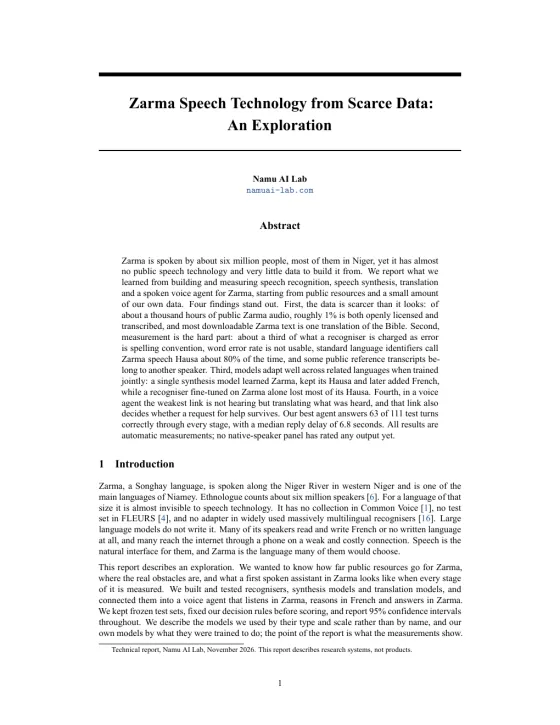
Zarma Speech Technology from Scarce Data: An Exploration
Namu AI LabNovember 202615 pagesPDF
Abstract
Zarma is spoken by about six million people, most of them in Niger, yet it has almost no public speech technology and very little data to build it from. We report what we learned from building and measuring speech recognition, speech synthesis, translation and a spoken voice agent for Zarma, starting from public resources and a small amount of our own data. Four findings stand out. First, the data is scarcer than it looks: of about a thousand hours of public Zarma audio, roughly 1% is both openly licensed and transcribed, and most downloadable Zarma text is one translation of the Bible. Second, measurement is the hard part: about a third of what a recogniser is charged as error is spelling convention, word error rate is not usable, standard language identifiers call Zarma speech Hausa about 80% of the time, and some public reference transcripts belong to another speaker. Third, models adapt well across related languages when trained jointly: a single synthesis model learned Zarma, kept its Hausa and later added French, while a recogniser fine-tuned on Zarma alone lost most of its Hausa. Fourth, in a voice agent the weakest link is not hearing but translating what was heard, and that link also decides whether a request for help survives. Our best agent answers 63 of 111 test turns correctly through every stage, with a median reply delay of 6.8 seconds. All results are automatic measurements; no native-speaker panel has rated any output yet.
Give this research more voices
What comes next needs consented speech from many more speakers. If you speak Hausa or Zarma, you can record short missions from your phone.